The eleven minutes after sunset when the sky turns cobalt and the city lights up — and how to walk in with a plan instead of hope.
022
OPERATOR PROTOCOL · PRO
“The sky gives you about eleven minutes. Amateurs spend them fumbling with settings. Operators spend them shooting.”
▶
Cynetis-7: The Contract1:24 · transmission incoming
Why the blue hour rewards the prepared and punishes the hopeful — and the one decision that matters most.
The Myth
The myth goes like this: blue hour is a lucky accident. You happen to be out, the sky happens to look good, you crank the ISO, fire off forty frames, and hope one of them has that deep-blue magic. When it doesn't work — and it usually doesn't — you decide you need faster glass, a better sensor, a newer camera. The myth says blue hour is a gear problem.
The Truth
The truth: blue hour is a contract with a schedule, and the light keeps its appointments to the minute. The sun drops below the horizon, the sky's brightness falls on a curve you can predict, the streetlights and windows switch on at a moment you can scout in advance. Nothing about it is luck. Your only job is to arrive with every decision already made — composition locked, exposure ladder planned, white balance chosen. The photograph is taken before sunset. After sunset, you just execute.
Cynetis-7 Transmission
“The night does not negotiate, operator. It offers you eleven minutes of cobalt and asks a single question: were you ready before it started? Readiness is the whole craft. The shutter is just the signature.”
— CYNETIS-7
PRO
The rest of this protocol is gated
This is where it gets serious.
Inside the vault: every operator step, the pro tip, the takeaway card, the field downloads — and the badge that proves you ran it.
6 operator steps · The Blue Hour Ladder
1Scout it in daylight, shoot it in blue.
2Set the exposure ladder before the light moves.
3White balance is a creative decision, not an accident.
4Sign the tripod contract.
5Bracket the decision, not the exposure.
6Know the exit.
Pro tip
Put the phone away for the first five minutes. The sky's best color happens while you're checking the preview …
Takeaway card · The Blue Hour Ladder
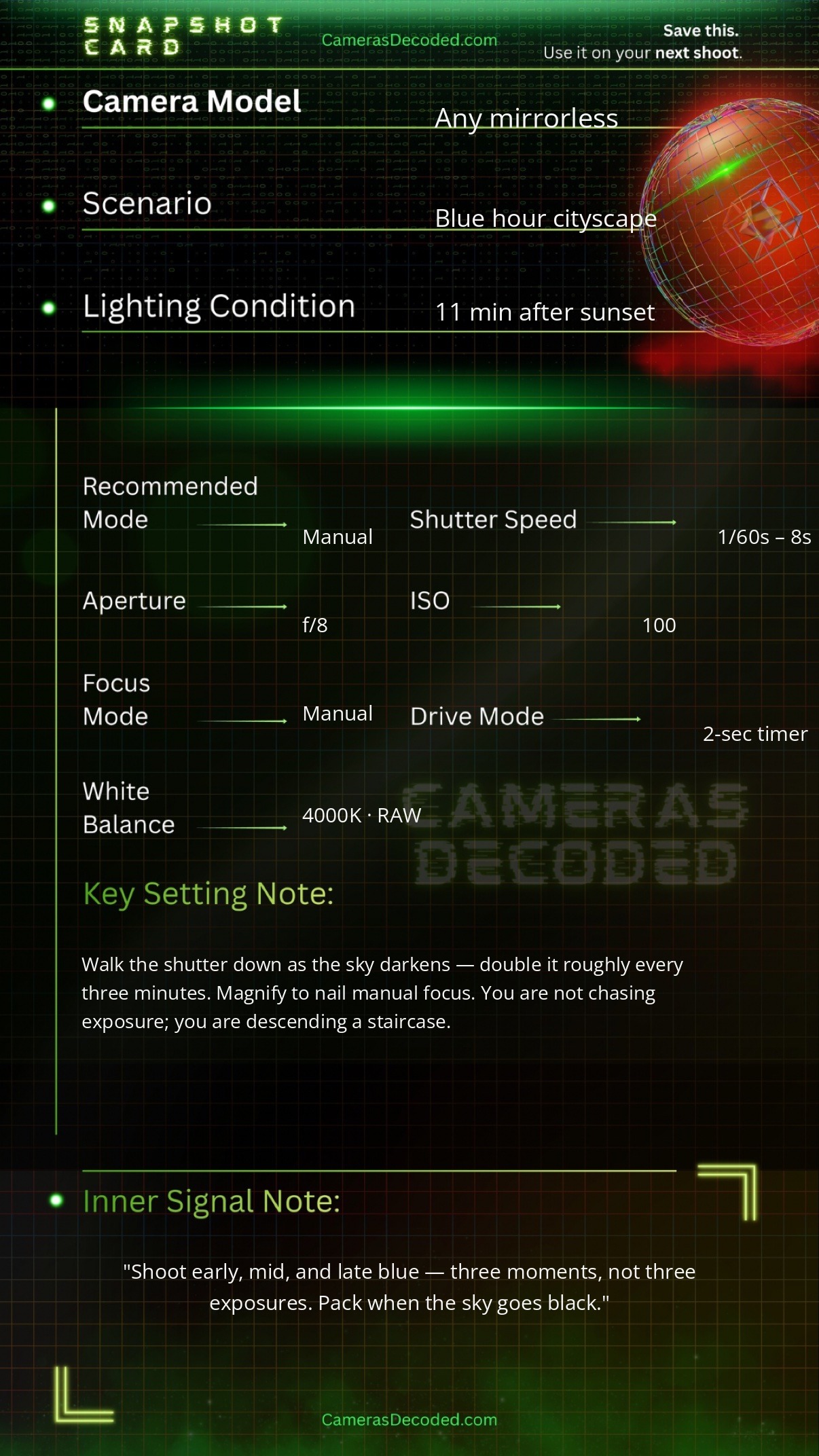
Scout at 4pm, lock the composition. Meter the sky, walk the shutter down: 1/60s → 8s at f/8, ISO 100, doubling…
Free readers keep the video, the myth, the truth & the transmission above. Pro finishes the job.
The Operator's Protocol — The Blue Hour Ladder
01
Scout it in daylight, shoot it in blue. The composition is locked before the sun goes down — never during. Arrive an hour early, find the frame at 4pm when you can still see the foreground clearly, and mark your tripod positions: a pebble, a crack in the pavement, the corner of a shadow. When the light arrives you should be able to set up blindfolded, because for the last three minutes of good light you nearly are.
02
Set the exposure ladder before the light moves. Meter the brightest part of the sky at sunset and walk the shutter down as the sky darkens. A working ladder at f/8, ISO 100: start around 1/60s while the sun's glow is still on the horizon, and double the shutter roughly every three minutes — 1/30, 1/15, 1/8, 1/4, 1/2, 1s, 2s, 4s, 8s — until the sky goes black. You are not chasing exposure. You are descending a staircase you built in advance.
03
White balance is a creative decision, not an accident. Auto white balance will murder the blue, warming eleven minutes of cobalt into muddy gray because the camera thinks the scene is 'too cold' and 'corrects' it. Lock it yourself: 4000K holds the cobalt honestly, 3200K pushes it toward cinematic teal. Shoot RAW regardless — but a deliberate in-camera choice means your previews tell the truth while you work, and truth is what keeps you shooting instead of chimping.
04
Sign the tripod contract. Two-second timer or a remote — your finger on the shutter is an earthquake at 4 seconds. Stabilization OFF on the tripod (it hunts for shake that isn't there and invents blur). Weigh the tripod down with your bag. On mirrorless, switch to the electronic shutter to kill shutter shock in the 1–8s range. Every one of these is a small discipline; together they are the difference between 'almost sharp' and a print.
05
Bracket the decision, not the exposure. Shoot the scene at three moments — early blue, mid blue, late blue — not three exposures of one moment. The changing light transforms the photograph more than ±1 EV ever will: early blue gives you foreground detail, mid blue gives you the cobalt, late blue gives you the city as pure signal against black. Pick your favorite in the warm edit, not in the cold street.
06
Know the exit. When the sky goes black and the foreground turns to mud, you are done — the contract has a closing time. Pack at the plan's end, not when frustration packs for you. Operators leave with three deliberate frames. Amateurs leave with forty hopeful ones and a dead battery.
Pro tip: Put the phone away for the first five minutes. The sky's best color happens while you're checking the preview of a shot you already nailed — and the preview will still be there when the color is gone. The color won't.
The Payoff
You walk away with a frame that looks like the city is holding its breath — cobalt sky, lit windows, water like glass — and the particular calm that comes from never having rushed. The next blue hour, you'll feel it before it starts: the quiet of someone whose decisions were made an hour ago.
“The night keeps its appointments. Start keeping yours.”
Takeaway — The Blue Hour Ladder
Scout at 4pm, lock the composition. Meter the sky, walk the shutter down: 1/60s → 8s at f/8, ISO 100, doubling every ~3 minutes. White balance locked at 4000K, RAW always. Tripod + 2s timer, stabilization off, bag as ballast. Shoot early / mid / late blue — three moments, not three exposures. Pack when the sky goes black.