Turn a Toy Car Into a Luxury Car With Forced Perspective
What is forced perspective?
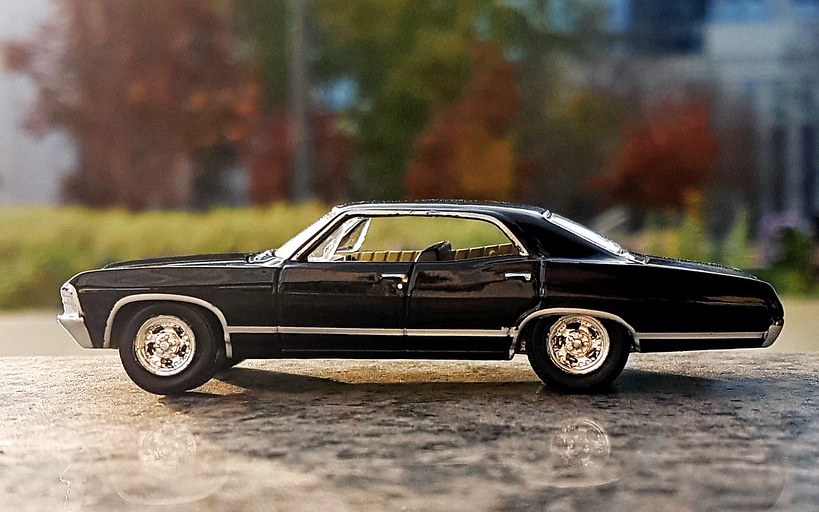
Forced perspective makes small things appear much larger than they really are. Filmmaker Peter Jackson did not magically shrink Elijah Wood in The Lord of the Rings; he shot it so the hobbits looked smaller and Gandalf looked bigger. Photographer Wendy Evans uses the same idea on a toy sports car, making it look like the real thing. The camera only knows where things sit in the frame.
How do you set it up?
Start with the base: a thin piece of plywood, covered in water-based glue and sprinkled with scenery gravel, then painted with lines. Card warps when the glue hits it, so plywood is worth the trip to a model shop. Set the base and car on a table, get down low, and line up the back edge of the base with the scenery behind it, so the base replaces the foreground and continues into the greenery. The background must plausibly have a road in front of it, so a car park works; a field does not.
What camera settings make it work?
Depth of field is the whole trick, and a crop sensor camera has an advantage: more depth of field at the same aperture than full frame. Evans shot a Nikon Z fc with the 16-50mm kit lens at 1/160sec, f/16, ISO400 in aperture priority, focusing on the part of the car nearest the camera so the background stays readable. Center-weighted metering overexposed at first, because the foreground was dark and the background bright; highlight metering fixed it. A tripod helps, and a phone works only in pro mode, where you can choose the aperture.
Why it matters for you
The best part of this project is the failure in it. Evans first tried 4 to 5cm metal cars, and it did not work: they were so small she had to get extremely close to make them look large, which would have needed a macro lens and made holding the background in focus impossible. The 25cm remote-control car worked perfectly. That is the lesson: scale is a decision, not a detail. A toy car, a sheet of plywood, and an afternoon teach more about depth of field and viewpoint than a new lens ever will.