How Far Can You Push Exposure Before Losing the Subject?
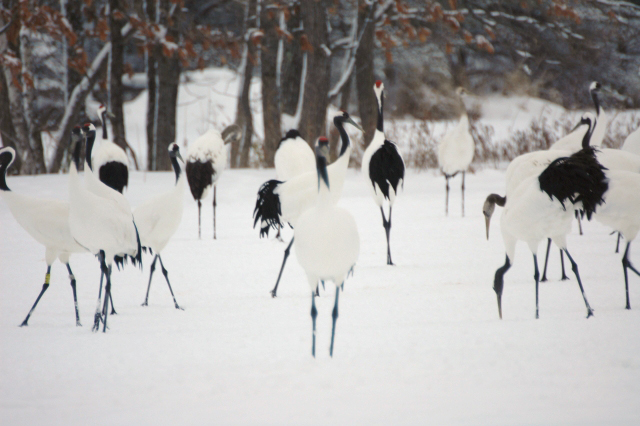
Why did he expose beyond what felt natural?
Prasad traveled to Hokkaido in January, when temperatures drop below minus 20 and the snow cover is at its heaviest. He worked the mornings, looking for fog rising off the spring-fed marshes to separate the cranes from their surroundings, and then did something that feels wrong: he pushed the exposure past what his instincts said was correct.
Snow fools a camera's meter into rendering a bright scene too dark, so some positive compensation is just correctness. Prasad went further, exposing right up to the edge of clipping. The reward: a photograph where the world dissolves into white and only the bird remains. The risk: pushed too far, the highlights burn and feather detail disappears.
How do you protect highlights in snow?
He watched the histogram in his electronic viewfinder while shooting, in real time rather than chimping after the fact. That is the strategy: expose bright, but let the histogram, not your gut, tell you where the edge is. He protected the highlights rather than the midtones, because in a high-key image the highlights are the image.
He also shot everything in RAW. When you are working this close to clipping, RAW is not a safety net, it is the working material.
What happens after the shutter?
The raw files were only halfway there. He first recovered snow detail with Lightroom's Exposure and Highlights sliders, then did the real transformation in Photoshop: hand-refined masks of the birds, inverted to select the background, pushed to maximum exposure, color flecks burned and cloned out. Finally he masked the birds' bodies, sparing the necks and red crowns, and desaturated the plumage.
The result reads more like ink-wash paintings than wildlife photographs. Wildlife photography does not always have to show off the rich color of feathers and fur; sometimes the boldest move is removing color altogether.
Why it matters for you
High-key is not a filter. It is a chain of decisions: expose bright but watch the histogram, protect highlights over midtones, shoot RAW, finish with careful masks. Try it with any bright background and dark subject, even a bird at the park against a bright sky. Expose until it feels slightly wrong, check the histogram, and see what survives.