A 5mm Spider, Shot 20 Times Life Size — and Sharp in Every Hair
Why can't one frame hold a spider at 20x magnification?
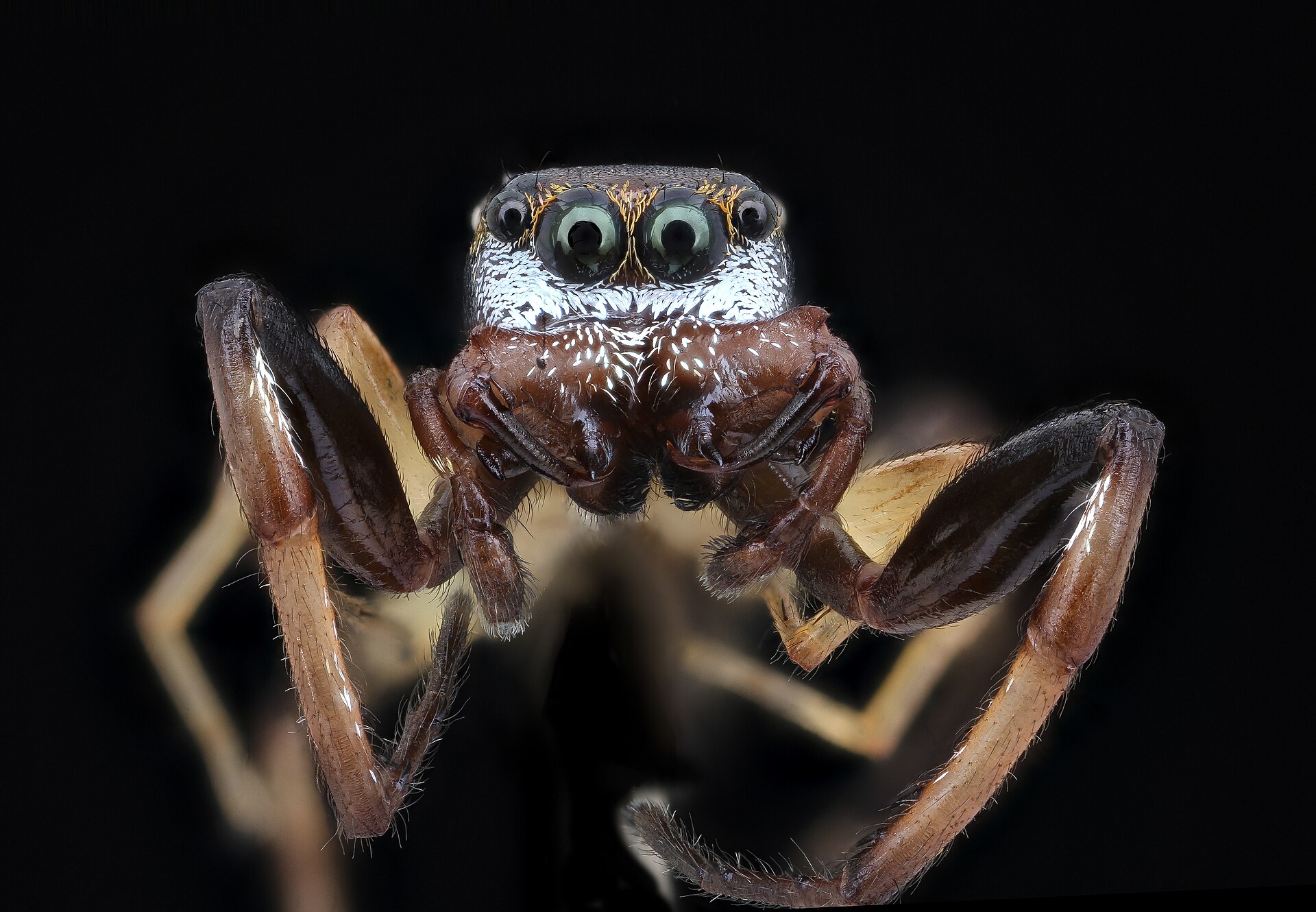
The subject is Salticus scenicus, a jumping spider common across Europe, typically 5 to 9 millimetres long. German photographer John-Oliver Dum photographed it at 20 times life size, and at that magnification depth of field shrinks to a sliver: a single frame can hold one thin slice sharp and nothing else.
What the stacking reveals is worth the trouble: two huge black eyes, a face fringed with fluffy white scales, fine hairs on its legs. Pollen grains too small to see with the naked eye look like jewels at this scale. Grains clustered on top resemble a crown, and one between the two main eyes resembles a pendant. The portrait took second place in the Nikon Small World 2026 Photomicrography Competition.
How does focus stacking build the sharp image?
Instead of fighting the shallow depth of field, Dum works with it. He shoots dozens of frames, sometimes more than 100, each focused a fraction deeper than the last, then merges them so everything is pin-sharp. His kit includes a Sony Alpha 1, an MJKZZ macro rail for precise focus steps, and microscope optics from Mitutoyo, Nikon, Olympus, and Carl Zeiss Jena. He typically works at magnifications from 1x to 100x.
The finished picture is not one exposure. It is dozens of small decisions about where sharpness should land, combined into a single image. That is the whole technique: depth you cannot capture in one frame, you build in many.
Where does this matter outside a microscope?
The same problem shows up at normal scale whenever the depth you need is wider than one exposure can hold. A landscape with a foreground a foot from the lens, a product shot, a watch at closest focus. One frame forces a choice between them; a stack refuses the choice.
Many mirrorless bodies now do the tedious part for you. Nikon, Canon, Sony, and Fujifilm all offer in-camera focus bracketing, which steps the focus automatically while you hold the shutter. The merging still happens in software, but the capture that once needed a rail and a microscope can now start as a menu setting.
Why it matters for you
Try it on something small this week. Turn on your camera's focus bracketing, or step the focus manually through a flower, a coin, or a watch at closest focus, and stack ten or twenty frames in free software. Compare the stack with the best single frame. The difference is the lesson: sharpness is not a property of the lens. It is a decision you make, frame by frame.